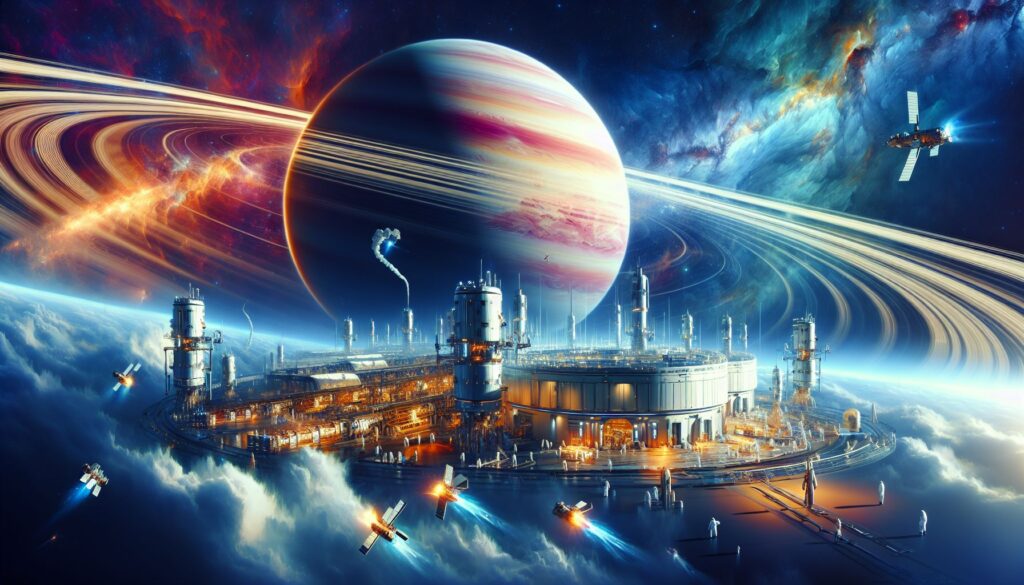
Hey there, fellow tech enthusiasts! Today, we’re going to blast off into an area that’s about as sci-fi as it gets: in-space manufacturing. Trust me, this isn’t just a page out of a science fiction novel; it’s happening right now as we speak, or type.
The New Universe of Manufacturing: Why Space?
Let’s start by getting to the heart of the matter. Manufacturing in space sounds insane, right? But think about it: no gravity, no weather, fewer restrictions, or much more freedom for designing new materials. For once, we’re not just dreaming; we’re doing.
SpaceX and Blue Origin have made rocket landings look as routine as your morning bus ride. This reduction in launch costs has opened up a treasure trove of possibilities for space technology, basically making space accessible like never before.
And speaking of possibilities, let’s talk about what we could actually build up there. Imagine fabrics that are softer than a baby’s blankie and stronger than titanium, or pharmaceuticals manufactured without the gravitational distortions that mess with chemical precision here on Earth. The weightlessness of space changes everything, allowing for the creation of entirely new forms of matter.
Zero Gravity, Zero Limits: The Advantages
So, why is the “cosmic carpet” a perfect lab? Gravity seems like a great thing here on Earth, but in manufacturing, it’s kind of a party pooper. Here’s how zero gravity is our new BFF:
Purity and Perfection
In a zero-gravity environment, materials can be produced with fewer impurities. It’s the Willy Wonka fantasy of pure, unadulterated chocolat—err, materials! Zero gravity allows particles to mix evenly, providing unmatched uniformity and high-quality outputs.
Innovative Alloys and Crystals
Space allows us to create materials that are impossible to make on Earth. Ever heard of ZBLAN? It’s a fiber-optic material that, when made in space, is almost without imperfections. That means higher transmission rates for data and fewer data losses. What other wonders can be made out there? The sky (or is it infinity?) is the limit.
Bioprinting in Space: The Health Frontier
I know what you’re thinking: bioprinting? That’s already a thing on Earth! True, but in space, the possibilities get wild. In a zero-g environment, cell structures can grow in more natural shapes than they can on the flattened terrain of Earth. So, one day, we might just “print” replacement organs right up there. How cool would it be to heal injuries or diseases without the hurdle of long donor waiting lists?
Challenges: The Space Road Isn’t All Smooth
Okay, before we get too starry-eyed, let’s chat about the challenges. It’s not all intergalactic ice cream and rainbows. Good ol’ space is freaking harsh! Radiation, extreme temperatures, microgravity—not exactly your friendly neighborhood workshop, right?
The Financial Galactic Jump
Yeah, it’s still pricey to send stuff into space. The economics need to be worked out, and that’s a project in itself. We’ve made strides in reducing launch costs, but the initial investment in equipment and research is a cosmic chunk of change.
Radiation and Reliability
Cosmic rays (a term that immediately makes you think of superheroes) are a constant threat. These can damage both the machinery and the materials being produced. Protecting against that just adds another layer to the complexity cake.
Looking Forward: The Final Frontier and Beyond
So what’s the end goal here? Efficiently creating space-based “factories.” This isn’t just going to benefit an elite crew of scientists and technocrats. We’re talking materials that can lower costs and up efficiency for everyone on this blue marble we call home.
Imagine hardware components for satellites built in space so they don’t have to endure the violent thrashing of Earth’s atmosphere. Or solar panels built straight from the solar system’s best energy resources: the sun.
Politicians have spoken about U.S. manufacturing jobs going to the moon, quite literally! And just think about the collaborative possibilities—why have a space race when you can have a space negotiation?
The Future Starts Now
We’re at the brink, folks. The cosmic door is cracking open, and soon, manufacturing could become as routine as setting up a pop-up shop on a busy street. All things considered, the astronauts of today could be the factory workers, or rather, factory overseers of tomorrow.
Dreams from our sci-fi novels are now scripting our reality as we chase this horizon. In-space manufacturing could completely redefine how we create, consume, and think about technological advancements. The universe, it seems, is our new workshop, and the final frontier is just the start.
Call me a starry-eyed optimist, but that’s an orbit I can’t wait to launch into. So grab your cosmic passport; who knows, the next Tesla or iPhone might just be “Made in Space!”
Catch you all on the next orbit,
[Your Cosmic-Curious Blogger]