The Architecture of Access: How Voting Rights Infrastructure Really Works

Understanding the Foundation: What Voting Rights Protection Actually Means

When we talk about voting rights protection, we’re really talking about infrastructure. Think of it like a bridge: you need solid engineering at every level, from the concrete footings to the safety railings, or the whole thing becomes unreliable for the people who need to cross it. Voting rights work the same way, requiring coordinated systems that span federal oversight, state administration, local implementation, and community advocacy.

The Architecture of Access: How Voting Rights Infrastructure Really Works

The Voting Rights Act of 1965 created what scholars call a “layered enforcement model.” Federal oversight through Section 2 prohibits discriminatory practices nationwide, while Section 4 originally established a preclearance formula requiring certain jurisdictions to get federal approval before changing voting procedures. When the Supreme Court struck down the preclearance formula in 2013’s Shelby County v. Holder decision, it removed something much more important than people realized. It was like taking out a load-bearing wall without reinforcing what remains.

This infrastructure approach helps explain why voting rights advocates focus so heavily on seemingly mundane details like polling place locations, ballot design, and voter registration deadlines. Each component either makes voting easier or creates friction in the process. A registration deadline 30 days before an election creates different access patterns than a 15-day deadline, just as surely as a highway on-ramp affects traffic flow.

Illustration for The Architecture of Access: How Voting Rights Infrastructure Really Works

The Multi-Level Coordination Challenge

Modern voting rights protection operates across at least four distinct governmental levels, each with different authorities and constraints. Federal agencies like the Department of Justice can investigate violations and file enforcement suits, but they can’t directly change state election laws. State governments control most election administration but must operate within federal constitutional and statutory parameters. County and municipal officials often handle day-to-day implementation but work within state frameworks.

This creates what political scientists call “intergovernmental friction.” It’s not necessarily conflict, but the natural tension that occurs when multiple authorities share responsibility for a complex system. Consider how early voting expansion actually happens: advocacy groups identify the need, state legislatures must change statutes, state election officials write implementation rules, and county clerks figure out staffing and locations. Each step involves different political dynamics and practical constraints.

The coordination challenge becomes especially apparent during election emergencies. When Hurricane Sandy hit the Northeast in 2012, New York and New Jersey had to rapidly adapt polling procedures while maintaining federal compliance and ensuring equal access. The states that responded most effectively had already built relationships between state officials, county administrators, disability rights advocates, and community organizations.

How Legal Strategy Shapes Practical Outcomes

Voting rights litigation operates on multiple timelines at once, creating a complex strategic environment. Emergency injunctions can halt problematic practices within days, but establishing lasting precedent through appeals can take years. This timing mismatch means that advocacy organizations must fight immediate threats while building long-term legal foundations at the same time.

The choice of legal venue significantly affects both strategy and outcomes. State court challenges often focus on state constitutional provisions, which can provide stronger protections than federal law but only apply within that state’s borders. Federal court cases can create broader precedents but must meet higher procedural hurdles and operate within current Supreme Court doctrine.

Consider the different approaches to redistricting challenges. Groups challenging gerrymandering in state courts have won significant victories in Pennsylvania, North Carolina, and other states by arguing that extreme partisan maps violate state constitutional requirements for fair representation. Meanwhile, federal challenges focus on racial vote dilution under the Voting Rights Act, requiring different evidence and legal theories but potentially creating precedents that apply nationwide.

Community Infrastructure and Civic Capacity

The most sustainable voting rights protections emerge from strong civic infrastructure at the community level. This includes formal organizations like local NAACP chapters and League of Women Voters groups, but also informal networks of civic engagement that develop over time. Communities with robust civic infrastructure can more effectively identify problems, mobilize responses, and maintain pressure for improvements.

Building this infrastructure requires understanding how different communities organize and communicate. Rural areas might rely heavily on church networks and local newspapers, while urban neighborhoods might organize around tenant associations or community development corporations. Effective voting rights work meets people where they already gather rather than creating entirely new organizational structures.

The most interesting developments often happen at the intersection of voting rights and other community priorities. When Detroit activists worked to ensure adequate polling locations during the city’s bankruptcy, they connected voting access to broader concerns about municipal services and community representation. When disability rights advocates push for accessible voting equipment, they’re building coalitions that strengthen multiple civil rights priorities at once.

Technology, Data, and Modern Enforcement

Contemporary voting rights protection increasingly relies on data analysis and technological tools that didn’t exist when the original Voting Rights Act passed. Statistical analysis can identify discriminatory patterns in polling place closures, voter registration rejections, or ballot access that might not be apparent from individual cases. Geographic information systems help advocates demonstrate how proposed changes would affect different communities.

This technological capacity creates new possibilities for both protection and violation of voting rights. Electronic pollbooks can streamline voter check-in but also create new points of failure. Online voter registration increases access but requires robust cybersecurity. Social media enables rapid voter education but also makes disinformation campaigns easier to spread.

The most sophisticated voting rights organizations now combine traditional legal advocacy with data science capabilities. They can quickly analyze whether a proposed polling place closure would disproportionately affect voters of color, whether new voter ID requirements would create barriers for elderly citizens, or whether ballot design changes might increase voter confusion. This analytical capacity doesn’t replace community organizing or legal expertise, but it strengthens both by providing precise documentation of problems and solutions.

Understanding voting rights as infrastructure helps explain why this work requires sustained attention rather than episodic mobilization. Just as bridges need regular inspection and maintenance, democratic systems need constant monitoring and adjustment to ensure they work for all citizens. The most successful voting rights efforts build long-term capacity while remaining flexible enough to respond to immediate challenges. Whether you’re interested in running for local office, supporting voter registration drives, or simply understanding how your own community’s election systems work, start by mapping the infrastructure that already exists and identifying where additional support might strengthen the foundation for everyone.
Your Vote Isn’t Enough: Why Real Civic Engagement Starts After Election Day

The Comfortable Myth of Ballot Box Democracy

Let me start with something that might sound heretical coming from someone who spends most Tuesday evenings at city council meetings: voting alone won’t save democracy. I know, I know. We’ve been told our entire lives that casting a ballot every two to four years is the pinnacle of civic duty. It’s a tidy narrative that fits nicely on bumper stickers and makes us feel accomplished after spending ten minutes in a voting booth.

Your Vote Isn't Enough: Why Real Civic Engagement Starts After Election Day
Your Vote Isn’t Enough: Why Real Civic Engagement Starts After Election Day

But here’s what I’ve learned after fifteen years of watching local government up close. The people who actually shape your daily life aren’t the ones you see on cable news. They’re the school board member who decides whether your kid’s classroom gets air conditioning, the planning commissioner who approves the apartment complex next door, and the parks director who determines whether that pothole-riddled trail gets fixed. These decisions happen in rooms where showing up matters more than showing off, and they happen year-round.

The uncomfortable truth? Our fixation on electoral politics has created a generation of civic spectators. We’ve been conditioned to think democracy is a seasonal sport, something that happens every few years when the yard signs sprout up. Meanwhile, the real work of self-governance continues in community meetings, public comment periods, and volunteer committees where the average age is somewhere north of retirement.

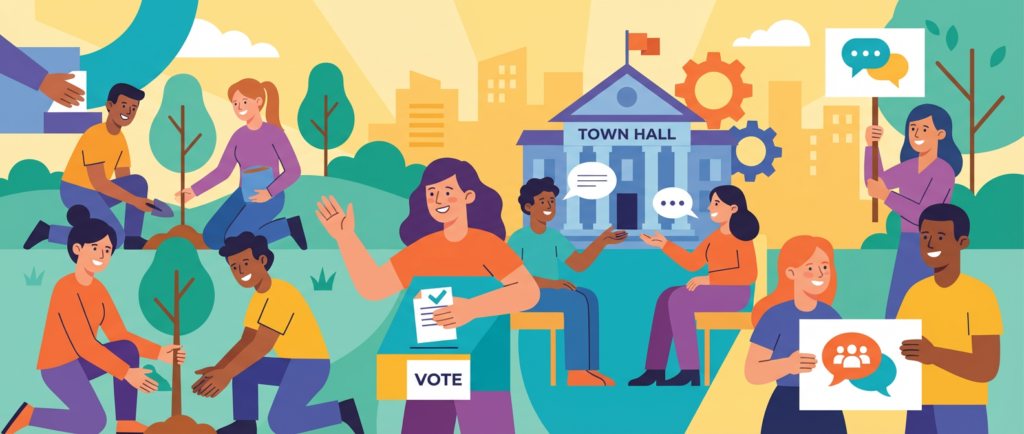
Illustration for Your Vote Isn't Enough: Why Real Civic Engagement Starts After Election Day
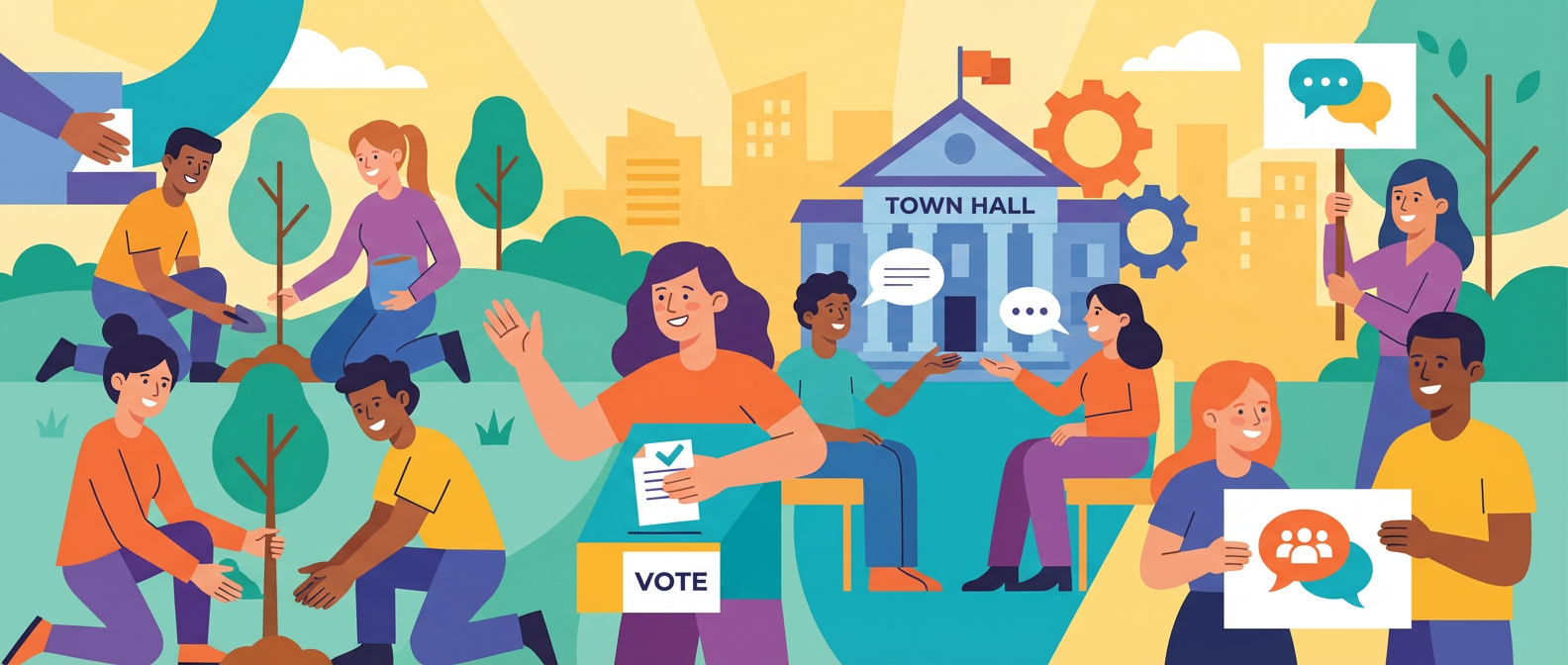
Illustration for Your Vote Isn’t Enough: Why Real Civic Engagement Starts After Election Day

Beyond the Ballot: Where Democracy Actually Lives

Real civic engagement looks nothing like what you see on television. It’s not dramatic speeches or heated debates. It’s Rita from the neighborhood association who noticed that the crosswalk timing doesn’t give seniors enough time to cross safely. It’s the group of parents who spent six months researching playground safety standards and then presented their findings to the parks department. It’s the small business owner who testified at three different hearings about how street parking changes would affect foot traffic.

These people understand something that pure voters don’t: democracy is a participation sport, not a spectator event. They’ve figured out that the gap between casting a vote and getting results is filled with unglamorous but essential work. They know which department handles pothole repairs versus which one manages tree trimming. They understand the difference between a city council meeting and a planning commission hearing. Most importantly, they’ve learned that showing up consistently matters more than showing up loudly.

I’ve watched neighborhood activists turn around failing schools, not by voting harder, but by attending school board meetings, building relationships with administrators, and organizing other parents to stay engaged between elections. I’ve seen residents save green space from development by learning zoning law, attending planning meetings, and presenting alternative proposals. These victories didn’t happen because someone pulled the right lever in November. They happened because people stayed engaged in January and March and July.

The Skills No Civics Class Teaches

Here’s what they don’t tell you in high school government class: effective civic engagement requires a completely different skill set than voting. You need to know how to research public records, how to speak effectively at public meetings, and how to build coalitions with people who might disagree with you on everything except the issue at hand. You need to understand bureaucracy well enough to know which office actually has the power to solve your problem.

Take something as simple as getting a stop sign installed. The voting-focused approach would be to complain about traffic safety during election season and hope your preferred candidate cares about the issue. The civic engagement approach involves researching traffic data, understanding the criteria your city uses for stop sign placement, attending the right meetings, and probably organizing your neighbors to document safety concerns. One approach feels more satisfying. The other actually works.

The most effective community advocates I know are policy nerds in the best sense. They can tell you the timeline for budget approval, explain how public comment periods work, and navigate the maze of departments and committees that actually make decisions. They’ve learned that preparation beats passion, that persistence beats protest signs, and that understanding process beats understanding politics.

Why Showing Up Changes Everything

The secret weapon of longtime community organizers is embarrassingly simple: they show up when no one else does. City council meetings, school board hearings, planning commission sessions. These gatherings often draw audiences you can count on two hands, which means your voice carries weight that would be impossible to achieve in electoral politics.

I’ve watched a single parent change district policy on homework by attending school board meetings for eight months straight. I’ve seen a group of five neighbors get a dangerous intersection redesigned by presenting traffic data at consecutive city council meetings. These people weren’t political insiders or wealthy donors. They were ordinary residents who understood that empty chairs represent opportunities.

The beautiful paradox of local civic engagement is that the lower the turnout, the higher your individual impact. That school board meeting with twelve people in attendance? Your comment represents eight percent of the audience. That planning commission hearing where you’re one of three speakers? You just influenced thirty-three percent of the testimony. This is democracy at its most responsive, where individual citizens can create change that affects thousands of their neighbors.

Building Democracy One Meeting at a Time

The path from voting to true civic engagement isn’t complicated, but it does require shifting your mindset from consumer to participant. Start by picking one issue that affects your daily life. Maybe it’s traffic safety in your neighborhood, or the condition of local parks, or how your school district handles special needs students. Then commit to following that issue for six months, not just until the next election.

Learn which government body handles your issue and when they meet. Most local governments livestream meetings now, so you can start by watching from home to understand the rhythm and process. Read the agendas beforehand. Look up the staff reports. Figure out who the key players are and what their positions seem to be. This isn’t about becoming a political expert overnight. It’s about becoming an informed participant in the decisions that shape your community.

The goal isn’t to replace voting with other forms of engagement. The goal is to fill the enormous gap between elections with the kind of sustained participation that makes democracy work. Your ballot matters, absolutely. But your presence in the spaces where decisions get made matters more. Democracy isn’t something that happens to you every few years. It’s something you do, meeting by meeting, issue by issue, until showing up becomes as natural as showing up to vote.

Ready to move beyond the ballot box? Start by finding your next city council meeting date and putting it on your calendar. Democracy is waiting for you to show up.

From Neighborhood Watch to City Hall: How Grassroots Organizing Built American Democracy

The Revolutionary Roots of Neighborhood Power

When Mercy Otis Warren organized her neighbors in Plymouth, Massachusetts to boycott British tea in 1773, she probably didn’t think she was establishing a template for modern community organizing. Yet the Committees of Correspondence that spread across colonial neighborhoods became the organizational backbone of the American Revolution. These local networks, built on kitchen table conversations and door-to-door canvassing, proved that ordinary citizens could challenge powerful institutions when they worked together systematically.

From Neighborhood Watch to City Hall: How Grassroots Organizing Built American Democracy

Warren and her contemporaries understood something that today’s neighborhood organizers keep rediscovering: real political power starts hyperlocally. The colonists didn’t begin by declaring independence from King George. They started by tackling immediate, tangible grievances in their own communities. High taxes on everyday goods. Soldiers quartered in private homes. Trade restrictions that hurt local businesses. These weren’t abstract policy debates. They were kitchen table issues that affected daily life.

The parallels to modern neighborhood organizing are striking. When residents in Detroit’s Corktown organized against predatory lending in 2008, or when parents in East Austin mobilized to save their elementary school library in 2019, they followed the same basic pattern. Identify a concrete problem affecting your neighbors. Build relationships through one-on-one conversations. Develop collective solutions. Apply pressure to decision-makers. The technology has changed, but the underlying mechanics remain remarkably similar.

The Progressive Era’s Organizing Playbook

Fast-forward to the late 1800s, and we see neighborhood mobilization evolving into something recognizably modern. Hull House, the Chicago settlement founded by Jane Addams in 1889, wasn’t just providing social services to immigrant families. It was teaching those families how to organize for better garbage collection, safer working conditions, and improved schools. Addams understood that charity without political empowerment was ultimately hollow.

The settlement house movement created what historian Robert Fisher calls “social work organizing,” blending direct service with political action. Residents didn’t just receive help; they learned to advocate for systemic change. When Hull House neighbors wanted the city to collect garbage more frequently, they didn’t just petition City Hall. They organized block by block, documented problems with photographs, and packed council meetings with affected residents who could speak from personal experience.

This approach produced concrete victories that improved thousands of lives. New playground ordinances. Factory safety regulations. Public health initiatives. More importantly, it created a generation of activists who understood that democracy requires active participation, not passive citizenship. Many Hull House alumni went on to lead major reform movements, carrying those organizing lessons to state and national levels.

The limitations of these historical parallels are worth noting. Progressive Era organizing often reflected the racial and class blind spots of its time. Many settlement houses helped primarily white immigrant communities while excluding Black residents. The organizing methods were effective, but they operated within systems that were themselves exclusionary. Modern organizers must learn from these successes while staying alert to the ways structural inequalities can undermine even well-intentioned efforts.

Civil Rights and the Power of Local Networks

The Montgomery Bus Boycott of 1955-1956 offers perhaps the clearest historical example of neighborhood organizing scaling up to transform society. The boycott’s success depended on a complex network of local institutions: Black churches, social clubs, labor unions, and informal neighborhood groups. When Rosa Parks was arrested, organizers didn’t start from scratch. They activated existing relationships and communication channels that had been built over years.

The Women’s Political Council, led by Jo Ann Robinson, had been organizing Montgomery’s Black community around bus segregation since 1950. They had researched ridership patterns, documented driver misconduct, and built relationships with potential allies. When the moment came, they could distribute 35,000 boycott flyers overnight because they already knew which neighbors could be trusted to spread the word efficiently.

This preparation wasn’t unique to Montgomery. Successful civil rights campaigns across the South relied on similar local organizing infrastructure. The Nashville Student Movement’s lunch counter sit-ins succeeded because organizers had spent months training participants in nonviolent tactics and building support networks within Black communities. The Mississippi Freedom Summer project worked because local activists like Fannie Lou Hamer had already been organizing rural communities around voting rights and economic justice.

What made these efforts historically important wasn’t just their moral clarity but their organizational sophistication. Civil rights organizers understood that lasting social change requires more than righteous anger. It requires methodical relationship-building, strategic planning, and the kind of unglamorous organizational work that happens long before the cameras arrive. Modern neighborhood organizers working on issues from housing affordability to climate resilience can learn enormous amounts from studying these campaigns.

Lessons for Today’s Neighborhood Organizers

These historical examples reveal several enduring principles that effective neighborhood organizers still follow today. First, successful organizing starts with listening, not talking. Whether it was colonial Committees of Correspondence or civil rights activists in the Deep South, effective organizers began by understanding their neighbors’ actual concerns, not their own assumptions about what those concerns should be.

Second, sustainable change requires building organizational capacity, not just winning individual campaigns. The movements that created lasting impact invested heavily in training new leaders, developing communication systems, and creating structures that could outlast any single issue or charismatic individual. They understood that democracy isn’t a spectator sport but a set of skills that must be continually practiced and refined.

Third, local organizing becomes powerful when it connects individual grievances to broader patterns of injustice. Hull House residents didn’t just complain about garbage collection; they connected sanitation issues to public health, worker productivity, and civic dignity. Civil rights organizers didn’t just protest bus segregation; they linked transportation access to economic opportunity, educational equity, and human dignity.

The digital age has created new tools for neighborhood organizing, but it hasn’t fundamentally changed these underlying dynamics. Social media can help organizers reach more neighbors more quickly, but it can’t replace the trust-building that happens through face-to-face conversations. Online petition platforms can generate impressive numbers, but they can’t substitute for the relationship-building that sustains long-term campaigns.

Building Tomorrow’s Democracy Today

Understanding this history helps contemporary organizers avoid two common traps. The first is thinking that their neighborhood’s problems are unprecedented and require completely novel solutions. Most community issues have deep roots and historical precedents that can inform current strategies. The second trap is assuming that because previous generations faced different circumstances, their organizing methods are irrelevant today.

The truth is more complicated. Technology changes, but human nature remains fairly consistent. People still respond to personal relationships, concrete benefits, and opportunities to exercise meaningful agency in their communities. They still need to see that their individual actions can contribute to collective progress. They still require organizations that can channel their energy toward strategic goals rather than random activity.

What’s your neighborhood’s version of the Committee of Correspondence or the Women’s Political Council? What existing relationships and institutions could form the foundation for effective organizing around the issues that matter most to your community? The answers will be specific to your local context, but the questions themselves connect you to a tradition of ordinary citizens who refused to accept the status quo and instead organized for the democracy they wanted to see.

Why Most Voter Guides Miss the Point (And How to Make Your Own That Actually Matters)

The Problem with Pre-Packaged Democracy

Every election cycle, well-meaning organizations flood our mailboxes and inboxes with voter guides promising to simplify our choices. The League of Women Voters publishes their comprehensive surveys. Local newspapers run candidate questionnaires. Interest groups rate politicians on single issues. These guides feel helpful, even essential, but here’s what I’ve learned after two decades of watching local elections: they’re often worse than useless.

Why Most Voter Guides Miss the Point (And How to Make Your Own That Actually Matters)

Most voter guides treat democracy like a consumer choice. They reduce complex candidates to bullet points and star ratings. They ask the wrong questions, focus on issues that sound important but rarely come before your city council, and create a false sense that you can make informed decisions by skimming a few paragraphs. Worse, they often reflect the biases and priorities of whoever created them, not the actual needs of your community.

This isn’t an argument against voter education. It’s an argument for better voter education. The kind that teaches you to fish instead of handing you a pre-caught dinner. When you learn to research candidates yourself, something remarkable happens: you start caring about local government in ways that stick around long after election day.

Illustration for Why Most Voter Guides Miss the Point (And How to Make Your Own That Actually Matters)

What Traditional Guides Get Wrong About Local Politics

The fundamental flaw in most voter guides is that they’re designed for state and federal races, then awkwardly applied to local contests. They ask mayoral candidates about abortion rights when the mayor has zero influence over reproductive policy. They quiz school board hopefuls about immigration when board members spend their time arguing about reading curricula and bus routes.

I remember receiving a voter guide that asked city council candidates to rate their agreement with statements like “Government should stay out of people’s personal lives.” It sounds relevant until you realize that city councils mostly deal with zoning variances, park maintenance, and whether to allow food trucks downtown. These abstract ideological positions tell you nothing about whether a candidate will fight for affordable housing or cave to developer pressure.

The real questions that matter in local races are frustratingly specific. Has this candidate attended city council meetings before running? Do they understand the difference between the city budget and the school budget? Have they ever dealt with a zoning issue, been on a local board, or organized neighbors around a community problem? These aren’t sexy questions. But they predict actual performance better than any position paper.

Traditional guides also miss the relational nature of local politics. Your city council member’s most important skill might be their ability to broker compromises between neighborhood associations, or their willingness to return phone calls about potholes. You can’t capture that in a multiple choice survey.

Building Your Own Research Framework That Works

Creating your own voter research system isn’t complicated, but it does require flipping your approach. Instead of starting with candidates, start with issues that actually affect your daily life. What frustrates you about your neighborhood? Traffic problems? Lack of affordable housing? Poor public transit? Struggling local businesses? These concrete concerns should drive your research, not abstract policy positions.

Once you’ve identified your priorities, the real detective work begins. Start attending city council or school board meetings, even if just virtually. Most local governments livestream meetings now, and watching even 30 minutes will teach you more about candidates than any voter guide. You’ll see who asks thoughtful questions, who’s done their homework, and who grandstands for the cameras.

Next, research what power the office actually holds. School board members can’t fix potholes. City council members usually can’t hire or fire the police chief directly. County commissioners might control health services that city officials cannot touch. Understanding these boundaries prevents you from voting based on promises candidates literally cannot keep.

Social media research, done carefully, reveals important information about candidates’ judgment and priorities. Look at what local issues they’ve posted about over time, not just during campaign season. Check if they engage respectfully with constituents who disagree with them. Pay attention to whether they share accurate information or spread misinformation about local government processes.

The Questions That Actually Predict Good Local Governance

After years of watching effective and ineffective local officials, I’ve identified questions that reliably predict performance. First: How long has this person lived in the community? Not because longevity automatically creates wisdom, but because local government requires understanding systems that evolved over decades. Someone who moved to town six months ago might bring fresh perspectives, but they’ll need time to understand why certain policies exist.

Second: What’s their track record of showing up? Have they attended public meetings, been on volunteer boards, or participated in community organizations? Local government is 90% showing up for boring meetings and building relationships over time. Campaign enthusiasm doesn’t substitute for this unglamorous foundation work.

Third: How do they handle disagreement? Local politics involves constant negotiation between competing interests. The candidate who dismisses opponents as corrupt or stupid will struggle to build coalitions needed to accomplish anything. Look for people who can articulate opposing viewpoints fairly, even when they disagree.

Fourth: Do they understand the budget? Local government is fundamentally about allocating limited resources. Candidates who make spending promises without explaining how to pay for them, or who think they can eliminate “government waste” without cutting services, reveal dangerous ignorance about municipal finance.

Why This Approach Changes Everything

When you research candidates yourself instead of relying on pre-made guides, something shifts in your relationship with local democracy. You start seeing patterns across multiple races. You begin recognizing the names of people who are on various boards and committees. You develop opinions about which local journalists ask the best questions and which community groups do the most effective advocacy.

This deeper engagement creates accountability that extends beyond elections. Officials who know constituents are paying attention behave differently than those who assume nobody’s watching. Your informed questions at public forums push candidates to think more carefully about complex issues. Your presence at city council meetings signals that democracy is working.

The research skills you develop also transfer across elections and issues. Once you’ve learned to evaluate a school board candidate’s qualifications, you can apply similar frameworks to county commissioners, state legislators, even ballot measures. You become a more effective citizen, not just a better voter.

Most importantly, doing your own research connects you with other engaged residents who share your commitment to informed participation. These relationships become the foundation for ongoing civic involvement that makes communities stronger between elections, not just during them.

I’d love to hear about your experiences researching local candidates, especially the surprising things you’ve discovered that never would have appeared in a traditional voter guide. What questions have you found most revealing? What resources have been most helpful in your community? Share your insights in the comments, and let’s build a better approach to local democracy together.

The Science of Sustainable Political Engagement: How to Advocate Without Burning Out

The Advocacy Burnout Epidemic Is Real

Political advocacy organizations report turnover rates of 40-60% annually, with burnout as the main reason activists walk away from causes they once cared about deeply. Research from the University of California’s Center for Community Engagement found that 73% of long-term advocates experienced at least one period of significant burnout during their first five years. These aren’t just numbers on a spreadsheet. They represent real people who started with genuine excitement about making a difference and ended up feeling overwhelmed, exhausted, and completely checked out.

The Science of Sustainable Political Engagement: How to Advocate Without Burning Out

The pattern repeats itself everywhere I look. Someone starts by phone banking for local candidates, attending city council meetings, or organizing neighborhood cleanups. That initial burst of energy crashes hard against the reality of slow progress and messy, complicated systems. What really gets me is that burnout hits everyone. It doesn’t matter if you’re liberal or conservative, twenty-five or sixty-five, brand new or experienced. I’ve talked to seasoned organizers who’ve run multiple successful campaigns, and they still go through cycles where they just can’t do it anymore.

But here’s the thing the data also reveals: advocates who use specific sustainability practices stay engaged much longer and actually enjoy their political involvement more. The secret is understanding that effective advocacy is a marathon, not a sprint. You need to train for it like any other long-distance challenge.

Illustration for The Science of Sustainable Political Engagement: How to Advocate Without Burning Out

Setting Boundaries That Actually Work

Effective advocacy boundaries aren’t about caring less or doing less important work. They’re about creating systems that let you show up consistently over time without completely burning out. Research from the Stanford Social Innovation Review identified three strategies used by advocates who stayed active for more than a decade: time limits, scope definition, and energy management.

Time limits mean you establish non-negotiable periods when you’re simply not available for advocacy work. Maybe you dedicate Tuesday and Thursday evenings to local government involvement while keeping weekends completely free for personal stuff. The most successful advocates treat these boundaries as seriously as a doctor’s appointment. They don’t let “urgent” but non-critical requests override their established limits.

Scope definition is about choosing your battles strategically instead of trying to fight every political battle at once. A study that tracked 200 community organizers over five years found something interesting: those who focused on 1-3 specific areas maintained higher energy levels and got more concrete results than those who scattered their attention everywhere. This doesn’t mean ignoring other important issues, but recognizing that your most effective contribution comes through sustained focus rather than trying to be everywhere at once.

Energy management acknowledges that political engagement takes an emotional and physical toll. Successful long-term advocates develop personal systems for processing difficult information, celebrating small wins, and bouncing back from setbacks. This might include regular debriefing sessions with trusted friends, maintaining hobbies that have nothing to do with politics, or creating rituals that help you transition between advocacy work and personal time.

The Power of Incremental Progress

One of the fastest ways to burn out is expecting dramatic change to happen quickly. Real political progress usually happens through lots of small victories accumulated over long periods. Understanding this helps you stay motivated when your individual efforts don’t produce immediate, obvious results.

Look at affordable housing advocacy in Minneapolis. Between 2010 and 2020, local advocates attended hundreds of city council meetings, organized dozens of community forums, and submitted countless public comments. To anyone watching from the outside, progress looked painfully slow for the first seven years. Then, in 2018 and 2019, the city approved significant zoning changes that enabled construction of thousands of affordable units. That “sudden” policy shift was actually the result of years of steady groundwork.

I recommend tracking your advocacy contributions to get a more accurate picture of how change actually happens. Keep records of meetings attended, calls made, emails sent, and conversations held. Over time, you’ll see patterns showing how your consistent involvement contributes to larger movements. This documentation has two benefits: it provides concrete evidence of your impact when your motivation starts flagging, and it helps you identify which activities produce the most meaningful results.

Successful advocates also learn what researchers call “process satisfaction” alongside “outcome satisfaction.” This means finding genuine fulfillment in the act of democratic participation itself, not just in policy victories. People who stay engaged long-term often describe satisfaction in learning how local government actually works, building relationships with neighbors who share their concerns, or developing new skills like public speaking or policy analysis.

Building Support Systems That Sustain

Political advocacy doesn’t have to be something you do alone, and research consistently shows that people with strong support networks stay engaged longer and experience less burnout. However, not all support systems work equally well. The most effective networks combine emotional support with practical assistance and shared learning opportunities.

Emotional support comes from relationships with people who understand the frustrations and rewards of political engagement. This might be other advocates working on similar issues, family members who respect your commitment even if they don’t share your level of involvement, or online communities focused on sustainable activism. The key is having regular contact with people who can provide perspective when setbacks feel crushing and celebration when victories happen.

Practical assistance means sharing the actual workload of advocacy activities. Research from the Harvard Kennedy School found that advocacy groups with strong task-sharing systems had 35% lower burnout rates than those where one or two people carried most responsibilities. This might mean rotating who takes notes at meetings, sharing research responsibilities, or coordinating carpools to events. The goal is making sure no single person becomes indispensable or gets completely overwhelmed.

Shared learning opportunities create environments where advocates can develop new skills while maintaining their existing commitments. Local organizations like the League of Women Voters often provide workshops on topics like candidate forums, ballot measure analysis, or effective public comment strategies. These sessions do multiple things: they improve your effectiveness, connect you with like-minded people, and provide intellectual stimulation that can reignite your enthusiasm for democratic participation.

Creating Your Personal Sustainability Plan

Sustainable advocacy requires intentional planning, just like any other long-term goal. The most effective personal sustainability plans include specific commitments, regular evaluation periods, and built-in flexibility for changing circumstances.

Start with an honest assessment of your current advocacy activities and energy levels. Which activities energize you versus drain you? What time commitments feel manageable versus overwhelming? Where do you see the clearest connection between your efforts and meaningful results? Use this information to design a sustainable baseline level of engagement that you can maintain even during busy or stressful periods in other areas of your life.

Schedule regular check-ins with yourself to evaluate how your advocacy involvement affects your overall well-being. Many successful advocates use quarterly reviews to assess what’s working, what needs adjustment, and what new opportunities align with their goals and capacity. These reviews help you make intentional choices about scaling involvement up or down rather than simply reacting to immediate pressures.

Build flexibility into your plan because life circumstances change and advocacy opportunities fluctuate. You might be available for intensive campaign work during election seasons but need to scale back during family transitions or work deadlines. Having a framework that accommodates these variations helps you stay engaged without feeling guilty about temporary reductions in activity.

Remember that sustainable advocacy is ultimately about playing the long game of democratic participation. Your consistent, thoughtful engagement over years and decades will have far greater impact than sporadic bursts of intense activity followed by periods of complete withdrawal. What aspects of this framework resonate most with your current advocacy experience, and where do you see opportunities to experiment with new approaches?

Running AI Characters Locally: The Hardware and Hassle You Actually Need

Beyond the Hype: Local AI’s Real Requirements

Local AI character generation has earned enthusiastic coverage across tech communities, and much of the positive attention is deserved. The promise of uncensored conversations, complete privacy, and freedom from service interruptions appeals to anyone frustrated with commercial AI limitations. Which is exactly why it’s worth taking a clear-eyed look at what’s not working.

This is one of those moments where paying attention pays off. The numbers tell part of the story, but only part.

Running sophisticated AI characters on your own hardware takes more than enthusiasm and a decent computer. The reality involves specific hardware thresholds, ongoing maintenance commitments, and technical knowledge that goes well beyond downloading an application. Understanding these requirements upfront can save hours of frustration and potentially expensive hardware purchases that fall short of expectations.

The Hardware Barrier: Why Your Gaming PC Might Not Cut It

The most immediate challenge facing anyone interested in local AI character inference centers on graphics processing power. Quality interactions with 7-billion parameter models need graphics cards equipped with at least 8 gigabytes of video memory. This specification eliminates many otherwise capable gaming systems that rely on 6GB or 4GB cards.

Budget-conscious users often discover that quantized GGUF model formats can enable CPU-only inference through llama.cpp implementations. While this approach removes the graphics card bottleneck entirely, it comes with noticeable quality compromises. Responses generate more slowly. The subtle nuances that make character interactions feel natural often disappear. The trade-off between accessibility and quality becomes particularly stark during longer conversations where model limitations compound.

Modern graphics cards meeting the 8GB threshold typically cost several hundred dollars. That’s a significant investment for hobbyist use. The RTX 4060 Ti, RTX 3070, and similar cards provide adequate performance, but users quickly discover that more video memory enables larger, more sophisticated models. This creates continuous upgrade pressure as new model releases push memory requirements higher.

Software Ecosystem: Navigating Backend Complexity

The software landscape for local AI character generation revolves around several key components that must work together. Oobabooga’s text-generation-webui and KoboldAI have emerged as the primary backend solutions that power character interactions through frontends like SillyTavern. Each backend offers distinct advantages, but both require configuration knowledge that extends beyond typical software installation.

SillyTavern is the user-facing interface where most character interactions occur, but its effectiveness depends entirely on proper backend configuration. The SillyTavern documentation provides comprehensive guidance, yet new users frequently struggle with the interconnected nature of model loading, parameter tuning, and prompt formatting. A misconfigured backend can make even high-quality models produce disappointing results.

Model selection dramatically influences the entire experience. Specialized fine-tuned versions consistently outperform base models for creative character roleplay. Uncensored variants trained specifically for fiction writing produce more engaging dialogue and maintain character consistency better than general-purpose models. However, identifying quality fine-tunes requires familiarity with the community ecosystem and ongoing model releases.

The Maintenance Reality: Updates, Bugs, and Compatibility

Local AI setups demand ongoing attention that extends well beyond initial configuration. Backend software receives frequent updates that can introduce breaking changes, requiring users to test compatibility with existing model files and frontend configurations. What works perfectly one week might fail completely after a routine update cycle.

Model files themselves represent another maintenance challenge. New releases promise improved quality or capabilities, but they also require storage space, download time, and compatibility testing. A single high-quality model can consume 8-15 gigabytes of storage. Maintaining several options for different use cases quickly fills available disk space. Users often find themselves managing multiple model versions while testing which combinations work best with their hardware and preferred backends.

The rapid pace of development in the local AI space means that configuration guides and tutorials become outdated quickly. Solutions that worked reliably six months ago might no longer represent best practices, leaving users to navigate conflicting information across forums, documentation, and community resources. This creates continuous learning requirements that some users find overwhelming.

Managed Alternatives: When Convenience Outweighs Control

The complexity and maintenance requirements of local setups have created demand for managed hosting services that eliminate hardware and configuration overhead. These services handle model hosting, backend management, and software updates while still providing access to uncensored models and private conversations. For users without strong technical backgrounds or those unwilling to maintain local installations, managed services offer compelling alternatives.

Platforms like Hearthside Chat demonstrate how managed approaches can deliver the benefits of local AI without requiring users to navigate hardware compatibility, software configuration, or ongoing maintenance tasks. The trade-off involves recurring subscription costs instead of upfront hardware investments, but many users find this exchange worthwhile given the complexity savings.

The choice between local and managed setups ultimately depends on individual priorities around control, privacy, cost, and technical involvement. Local installations provide maximum flexibility and long-term cost efficiency for users willing to invest time in learning and maintenance. Managed services prioritize convenience and reliability for users who prefer to focus on character interactions rather than infrastructure management. Both approaches have legitimate uses within the growing community of AI character enthusiasts.

hearthside.chat is built around the open-source roleplay frontend — a good option if you want a managed setup rather than running the stack yourself.

Understanding the mechanism matters as much as knowing the outcome. Find your rep and make the call today.

The Great Voting Rights Paradox: Why Both Sides Are Right (And Wrong) About Election Security

The False Choice We’ve Been Handed

Walk into any coffee shop in America and mention voting rights, and you’ll likely witness the same tired debate unfold. One side passionately argues that voter suppression is rampant, that every barrier to voting is a deliberate attempt to silence voices. The other insists with equal fervor that election integrity is under siege, that fraud runs rampant while officials look the other way. Both camps retreat to their corners, convinced the other side is either naive or malicious.

The Great Voting Rights Paradox: Why Both Sides Are Right (And Wrong) About Election Security

Here’s what I’ve learned from twenty years of watching local elections up close: this isn’t actually two opposing positions. It’s two people describing different parts of the same broken system. The real tragedy isn’t that we disagree about voting rights. It’s that we’ve been tricked into thinking we have to choose between access and security when the best election systems deliver both.

Take Oregon’s vote-by-mail system, started in 1998. Voters get ballots weeks before Election Day, giving them time to research candidates and issues. They can vote at their kitchen table, ask questions, and drop their ballot in the mail or at secure drop boxes. The result? Oregon consistently ranks among the top states for both voter turnout and election security. No massive fraud, no voter suppression. Just a system designed to work for everyone.

Where the Access Advocates Get It Right (And Wrong)

The voting rights protection movement has documented real problems that deserve attention. When Georgia closed over 200 polling locations between 2012 and 2018, mostly in communities of color, that wasn’t abstract policy. Real people lost access to their fundamental right to vote. When Texas requires specific forms of photo ID but won’t accept student IDs from state universities, that’s not neutral election administration. It’s a barrier that hits young voters hardest.

These advocates understand something important: voting shouldn’t require heroic effort. Democracy works best when participation is as simple as possible for eligible citizens. They’ve successfully pushed for extended early voting hours, online voter registration, and automatic registration systems that have expanded access without hurting security.

But here’s where the movement sometimes trips up: treating every security measure as suspicious. When Iowa started post-election audits to verify vote counts, some advocacy groups opposed it as “voter intimidation.” When states moved to update voter rolls by removing people who had died or moved away, lawsuits followed claiming voter purges. This knee-jerk opposition to reasonable security measures hands ammunition to critics and hurts the movement’s credibility.

The most effective voting rights advocates I know have learned to tell the difference between real security improvements and politically motivated restrictions. They support signature verification systems while opposing exact-match signature requirements. They back reasonable deadlines for voter registration while fighting arbitrary shortened registration periods. This smarter approach builds broader coalitions and creates lasting change.

Where the Security Hawks Make Valid Points (And Miss the Mark)

Election security concerns aren’t made up. The Heritage Foundation has documented over 1,400 instances of voter fraud resulting in convictions since the 1990s. While that’s a tiny percentage of votes cast, it represents real crimes that hurt public confidence in elections. States have legitimate reasons to maintain accurate voter rolls, verify voter eligibility, and ensure ballot integrity.

Election security isn’t just about fraud prevention, either. It’s about creating systems strong enough to handle human error, technical glitches, and potential foreign interference. When Wisconsin discovered that a software error had miscounted votes in a 2020 local race, that wasn’t fraud, but it showed why post-election audits and backup systems matter.

The security-focused crowd also gets something voting rights advocates sometimes miss: public confidence matters. If voters don’t trust that elections are conducted fairly and accurately, democracy itself suffers. Reasonable verification measures, transparent processes, and solid auditing systems don’t suppress votes. They protect the legitimacy of every vote cast.

But security hawks often propose solutions that create more problems than they solve. Exact-match signature verification sounds reasonable until you realize that signatures naturally change over time, and training poll workers to make forensic comparisons isn’t realistic. Voter ID requirements make sense in theory but become problematic when getting required documents costs money or requires travel to distant offices with limited hours.

Building Systems That Actually Work

The best election reforms I’ve seen combined expanded access with better security. Colorado’s system shows how this works. Every registered voter automatically gets a mail ballot, dramatically increasing turnout. But the state also requires signature verification, maintains detailed chain-of-custody procedures, and conducts risk-limiting audits after every election. The result is both high participation and high confidence in results.

Automatic voter registration systems address security concerns while expanding access too. When citizens interact with government agencies, their information is automatically verified and they’re registered to vote unless they opt out. This creates more accurate voter rolls while making sure eligible citizens can participate without extra bureaucratic hurdles.

The most promising developments happen at the local level, where election administrators focus on practical solutions rather than political talking points. In Michigan, clerks from both parties worked together to create online ballot tracking, letting voters confirm their absentee ballots were received and counted. In Utah, bipartisan legislation created a pilot program for mobile voting units serving rural communities and voters with disabilities.

These successes share common elements: they solve real problems rather than imaginary ones, they include input from all stakeholders, and they’re designed to improve the voting experience for everyone. They prove that the choice between access and security is false. Well-designed systems deliver both.

Moving Forward Together

The path forward requires dumping the tribal thinking that has dominated voting rights debates. Instead of asking whether proposed changes help “our side,” we should ask whether they help democracy itself. Does this reform make it easier for eligible citizens to vote? Does it boost confidence in election results? Does it create more accurate, transparent, and efficient election administration?

This means voting rights advocates should support reasonable security measures that don’t create unfair burdens on voters. It means security-focused reformers should back access improvements that don’t compromise election integrity. Most importantly, it means all of us should demand better from our election systems instead of accepting the status quo.

The next time someone tells you we must choose between voting access and election security, remember Oregon, Colorado, and the dozens of other places proving that’s a false choice. Great democracies don’t ration participation or compromise on integrity. They build systems worthy of the citizens they serve.

What voting rights issues matter most in your community? I’d love to hear about local efforts to improve election systems, whether focused on access, security, or both. The best ideas often start with citizens who refuse to accept that things can’t be better.

Beyond the Campaign Flyers: A Step-by-Step Guide to Actually Researching Your Candidates

Start With What They’ve Actually Done, Not What They Say They’ll Do

The glossy mailers flooding your mailbox right now want to make you feel something, not think something. That’s fine for soap commercials. But when you’re choosing who gets to make decisions about your tax dollars and your neighborhood’s future, you need facts. The most reliable predictor of how a candidate will govern isn’t their campaign promises. It’s their track record.

Beyond the Campaign Flyers: A Step-by-Step Guide to Actually Researching Your Candidates

Start your research with a simple question: What has this person actually accomplished? If they’re an incumbent, look at their voting record on city council, school board, or county commission. Most local governments post meeting minutes and voting records online, though you might need to call the clerk’s office if the website is terrible. For newcomers to politics, look at their professional background, volunteer work, and involvement in community organizations. A candidate who’s never shown up to a city council meeting before deciding to run for mayor? That tells you something important about their commitment level.

Don’t just skim their resume. Verify it. That “small business owner” might run a consulting firm with no employees, while the “education advocate” might have attended exactly two school board meetings in the past five years. Cross-reference their claims with public records, LinkedIn profiles, and news coverage. It takes fifteen minutes of focused searching to separate genuine community leaders from ambitious ladder-climbers.

Follow the Money Trail (It’s Easier Than You Think)

Campaign finance reports are public documents. They’re goldmines of information about who a candidate really represents. Every state has different filing requirements and databases, but the information is out there if you know where to look. Start with your state’s ethics commission or secretary of state website. They usually maintain searchable databases of campaign contributions and expenditures.

Pay attention to patterns, not just totals. A candidate funded primarily by small donations from local residents has different incentives than one bankrolled by out-of-state developers or industry PACs. Look at the timing too. Early money often comes from the candidate’s real base of support, while late money might reflect bandwagon jumping or calculated bets on likely winners. If you see the same names or companies showing up across multiple races, you’ve identified power brokers worth researching further.

Don’t ignore expenditures either. How candidates spend their money reveals their priorities and competence. Are they paying reasonable rates for professional services, or enriching family members with no-bid contracts? Are they investing in voter outreach and policy research, or blowing everything on expensive consultants and flashy events? A candidate who can’t manage a campaign budget responsibly probably shouldn’t manage a government budget.

Test Their Knowledge With Specific Local Issues

Here’s where you separate the serious candidates from the seat-warmers: Ask them detailed questions about actual problems facing your community. Not vague softball questions about “improving the economy” or “supporting families.” Specific policy challenges that require real knowledge and thoughtful solutions.

Come armed with facts. If your city is facing a budget shortfall, ask candidates exactly how they’d address it. Which services would they cut, which taxes would they raise, or what efficiencies would they find? If there’s a controversial development project in your neighborhood, ask them about zoning laws, environmental impact studies, and traffic flow analysis. If your schools need funding, ask them to explain the difference between operating budgets and capital improvements, or how state funding formulas actually work.

The best candidates will admit when they don’t know something and explain how they’d find the information they need. Red flags include candidates who blame everything on “corruption” or “politics as usual” without offering concrete solutions. Those who promise simple fixes to complex problems. Anyone who gets defensive when pressed for details. Local government is detail work. If they can’t handle detailed questions during the campaign, they can’t handle the job.

Use Multiple Sources and Cross-Check Everything

Smart researchers triangulate. That means checking the same information across multiple independent sources before accepting it as fact. Local newspapers often have the most thorough candidate coverage, but don’t stop there. Check out candidate forums hosted by civic groups, many post video recordings online. Read endorsement articles from different organizations to understand their reasoning, even if you disagree with their conclusions.

Social media can be revealing, but use it carefully. A candidate’s Twitter feed from three years ago might show their true personality and priorities better than their polished campaign website. But remember that people change and context matters. Screenshots can be manipulated, and quotes can be taken out of context. If you find something concerning, try to verify it through other sources before factoring it into your decision.

Don’t forget about opposition research, but apply the same skeptical standards to negative information that you do to positive claims. Attack ads and critical articles might contain accurate information, but they’re designed to persuade, not inform. Check the sources, look for missing context, and consider the motivations of whoever’s doing the attacking. Sometimes negative campaigning reveals more about the attacker than the target.

Put It All Together and Make Your Choice

Good research doesn’t guarantee perfect candidates. It just helps you make informed choices among imperfect human beings. After you’ve gathered your facts, step back and consider the big picture. Which candidates have demonstrated competence in relevant areas? Who seems to understand the actual challenges facing your community? Whose values and priorities align most closely with yours, based on their actions rather than their words?

Remember that different offices require different skills. A great school board candidate might be terrible for city council. An excellent county commissioner might be wrong for mayor. Match the candidate’s demonstrated abilities to the specific job they’re seeking. Local government affects your daily life more directly than state or federal politics. The quality of your roads, schools, parks, and public safety all flow from decisions made by people whose names you might not even recognize.

The research process itself is just the beginning. Once you’ve done your homework and made your choices, follow through by actually voting. Keep paying attention after the election. The candidates who win will need engaged citizens holding them accountable for the promises they made and the trust you placed in them. Democracy isn’t a spectator sport. It’s a participation requirement.

Your Neighbor’s Vote Matters More Than You Think: How to Build a Local Election Voter Guide That Actually Works

The Tuesday That Changed Everything

Last November, 127 people decided whether the vacant lot on Maple Street would become affordable housing or luxury condos. Not 127,000 people. Just 127. That’s how many voters showed up for a special election about a zoning variance that will shape one neighborhood for the next thirty years. The developer won by eight votes.

This is the reality of local elections. While cable news obsesses over presidential polls, the decisions that directly touch your daily life happen in school board meetings, city council chambers, and county commissioner offices. Your property taxes, your kid’s classroom size, the pothole outside your house, the hours your library stays open. These aren’t abstract policy debates. They’re Tuesday night decisions made by people whose names you might not even know.

Why Your Block Needs Its Own Political Playbook

Local voter guides aren’t just smaller versions of national election resources. They need a completely different approach because local races operate by different rules. In my city of 85,000 people, our mayoral race last year came down to 43 votes. When margins are that thin, every conversation matters. Every neighbor you help register matters. Every friend you walk through their ballot matters.

The traditional model assumes voters will research candidates independently. But local candidates often have minimal online presence, limited media coverage, and campaign budgets smaller than most people’s monthly rent. That school board candidate might be brilliant, but if her entire digital footprint is a Facebook page with twelve followers, how will anyone learn about her background in special education advocacy?

This is where grassroots voter guides become essential infrastructure. Not partisan endorsement sheets, but practical tools that help your neighbors make informed choices about the people who will literally decide whether their street gets repaved next year.

Building Your Guide From the Ground Up

Start with the races that matter most to your community right now. In my neighborhood, we focused our first guide on the three city council seats up for election because residents had been fighting for better snow removal for two winters straight. We interviewed all six candidates about their specific plans for public works funding. No vague promises about “improving services.” We asked for dollar amounts, timelines, and which streets would be prioritized.

The best local voter guides answer the questions your neighbors are actually asking. Attend a few city council meetings and listen. Read the letters to the editor in your local paper. Join neighborhood Facebook groups and pay attention to recurring complaints. When parents keep posting about overcrowded playgrounds, that’s your cue to ask parks and recreation candidates about their capital improvement priorities.

Format matters more than you might expect. Our most successful guide was a single-page flyer we could slip under doors and post on community bulletin boards. We included three key pieces of information for each candidate: their relevant experience, their position on the top local issue, and how to learn more. That’s it. People can absorb that much information while standing in their doorway sorting mail.

The Art of the Candidate Interview

Reaching local candidates is easier than you think, but it requires strategy. Don’t email. Call. Better yet, show up at their campaign events or the coffee shops where they’re trying to meet voters. Local candidates are usually thrilled that someone wants to ask substantive questions. They’re used to voters who know nothing about their background or platform.

Ask specific, practical questions tied to your community’s immediate needs. Instead of “What’s your position on education funding?” ask “Lincoln Elementary is losing its art teacher due to budget cuts. How would you restore that position?” Instead of “How will you address traffic safety?” ask “The intersection at Oak and Third has had six accidents this year. What’s your plan for that specific location?”

Give candidates equal time and identical questions. This isn’t about being perfectly neutral. It’s about being credible. When you publish responses showing that one candidate gave detailed, researched answers while another offered empty talking points, that contrast speaks for itself. Let the candidates’ own words reveal their preparedness and priorities.

Distribution: Getting Your Guide Into Actual Hands

The most comprehensive voter guide is useless if it stays on your website. Local elections require local distribution networks. Partner with organizations that already have community trust: neighborhood associations, parent groups, faith communities, small business associations, tenant unions. These groups have email lists, bulletin boards, and regular meetings where civic information is welcome.

Timing matters for local elections. Many voters don’t realize there’s an election happening until they see campaign signs pop up a few weeks before voting day. Start distributing your guide six weeks before the election, then push it again in the final two weeks. Set up a simple table outside the grocery store or farmer’s market. People will stop and talk when they see local candidate information.

Don’t underestimate the power of physical copies. Yes, create a digital version for social media sharing. But also print enough flyers to leave stacks at coffee shops, libraries, and community centers. Include a QR code linking to the online version so people can easily share it. Local elections are still largely analog experiences, especially for older voters who participate most consistently in off-year elections.

Beyond Election Day: Building Lasting Civic Engagement

The most effective voter guides don’t disappear after election day. They turn into ongoing accountability tools. Track the promises candidates made during the campaign and follow up on them in office. Create simple scorecards showing how elected officials vote on key issues. This kind of follow-through builds trust with your community and makes future voter guides more credible.

Consider starting small with one race or one issue, then expanding based on what you learn. Our first guide covered three city council candidates and took twenty hours of work. Our second guide covered every local race and took forty hours, but we had systems in place and community partnerships that made the process smoother.

What started as a one-time project to help neighbors navigate a confusing ballot can become the foundation for sustained civic engagement in your community. Democracy isn’t just about showing up every four years for presidential elections. It’s about paying attention to the decisions happening in your backyard and helping your neighbors do the same.

Your Voice in the Town Square: A Citizen’s Guide to Meaningful Public Meeting Participation

The Ancient Art of Democratic Participation

Picture this: it’s 508 BCE in Athens, and citizens are gathering in the agora to debate whether their city-state should build new defenses against Persian threats. The stakes are high, voices are passionate, and every citizen who speaks could sway their community’s fate. Fast-forward 2,500 years to your local city council chambers, and the fundamental dynamic remains remarkably similar. Whether you’re advocating for better streetlights or opposing a controversial development, you’re participating in democracy’s oldest tradition.

Your Voice in the Town Square: A Citizen's Guide to Meaningful Public Meeting Participation
Your Voice in the Town Square: A Citizen’s Guide to Meaningful Public Meeting Participation

The comparison isn’t perfect, of course. Ancient Athens excluded women, slaves, and non-citizens from participation, while modern public meetings theoretically welcome all community members. But the core challenge remains unchanged: how do ordinary citizens effectively influence the decisions that shape their daily lives? The answer lies not in grand gestures or political theater, but in understanding the rhythms and requirements of democratic debate.

Just as Athenian citizens learned to navigate the protocols of the ecclesia, today’s engaged residents must master the art of public meeting participation. The good news? Unlike ancient Greece, you don’t need to own property or complete military service to have your say. You just need preparation, persistence, and a healthy respect for the process.

Research Like Your Neighborhood Depends on It

Before you step into any public meeting, remember that knowledge is your most powerful tool. The most effective public speakers aren’t necessarily the most charismatic. They’re the ones who’ve done their homework. Start by thoroughly understanding the issue at hand. Read the staff report, review the agenda, and familiarize yourself with relevant municipal codes or policies. This isn’t academic exercise. It’s strategic preparation.

Dig into the background of decision-makers too. Learn about your council members’ voting patterns, their stated priorities, and their responsiveness to constituent concerns. Ballotpedia and your local government website are treasure troves of this information. Understanding who you’re speaking to allows you to frame your arguments in ways that resonate with their established positions and values.

Don’t overlook the procedural aspects either. Most public meetings follow Robert’s Rules of Order or similar parliamentary procedures. Knowing whether you can interrupt during discussion periods, how long you have to speak, and when public comment occurs will help you maximize your impact. Call the city clerk’s office if you’re unsure. They’re usually happy to explain the process to engaged citizens.

Finally, connect with other stakeholders before the meeting. Democracy works best when citizens coordinate their efforts rather than duplicate them. If five people plan to make the same point about traffic safety, consider having them each address different aspects of the issue instead. This creates a more compelling narrative and demonstrates broader community engagement.

Crafting Your Message for Maximum Impact

Think of your public comment as a cross between an elevator pitch and a closing argument. You typically have two to three minutes to make your case, which means every word counts. Start with a clear statement of your position, follow with your strongest evidence, and end with a specific request for action. Avoid the temptation to cover every possible angle. Focus on what matters most.

Personal stories carry tremendous weight in public forums, but use them strategically. Instead of simply sharing your experience, connect it to broader community interests. Rather than saying “the potholes on my street are terrible,” try “the deteriorating road conditions on Maple Street reflect a maintenance backlog that affects property values and emergency response times throughout the district.” This approach transforms individual grievances into community-wide concerns.

Anticipate counterarguments and address them proactively. If you’re advocating for increased library funding, acknowledge budget constraints while proposing specific revenue sources or cost-saving measures. This demonstrates that you understand the complexity of governance and aren’t simply demanding the impossible.

Time your delivery carefully too. Speaking early in a long meeting ensures decision-makers are alert and engaged. However, if you’re responding to specific points raised in discussion, waiting until later in the public comment period might be more effective. Watch the room’s energy and adapt accordingly.

Mastering Meeting Dynamics and Follow-Through

Public meetings have their own ecosystem of formal procedures and informal dynamics. Arrive early to sign up for public comment and observe the meeting’s rhythm before your turn to speak. Notice how other speakers approach the podium, whether they use visual aids effectively, and how decision-makers respond to different presentation styles.

When your moment comes, maintain eye contact with council members rather than reading directly from notes. This creates connection and demonstrates confidence in your message. Speak clearly and at a measured pace. Nervous energy often leads to rushed delivery that undermines otherwise strong arguments. If you’re presenting data or documents, bring copies for each decision-maker and the clerk.

Remember that public comment is just one part of a larger advocacy strategy. The most successful community advocates treat meetings as waypoints in ongoing relationships with elected officials. Follow up your public comment with emails that provide additional information or clarify points you made. Request individual meetings with sympathetic council members to explore potential solutions in greater depth.

Build coalitions that extend beyond single issues too. The resident who supports your position on bike lane safety today might need your help advocating for senior services next month. These relationships create the sustained political pressure necessary for meaningful policy change. Democracy isn’t a spectator sport. It’s a team effort that requires ongoing participation and mutual support.

The Long Game of Democratic Engagement

Perhaps the most important lesson from studying democratic participation across centuries is that change rarely happens overnight. The abolitionists didn’t end slavery with a single speech, and the suffragettes didn’t win voting rights through one well-crafted petition. They succeeded through sustained, strategic engagement that built momentum over time.

Apply this historical perspective to your own advocacy efforts. Celebrate small victories while maintaining focus on larger goals. If your first attempt to address a community issue doesn’t succeed, analyze what you learned and adjust your approach. Maybe your timing was off, or perhaps you need to build broader coalition support before returning to the public forum.

Document your efforts too. Keep records of meeting dates, officials’ responses, and commitments made during public sessions. This documentation becomes invaluable for holding leaders accountable and demonstrating patterns of community concern. Share your experiences with other residents who might be intimidated by the public meeting process. Your knowledge and encouragement could be the catalyst that transforms a passive observer into an active participant.

Local democracy depends on citizens who understand that their voices matter and know how to make them heard effectively. Every time you research an issue, attend a meeting, or follow up on commitments made by elected officials, you’re participating in the same democratic tradition that has shaped communities for millennia. The stakes may seem smaller than those faced in ancient Athens, but the cumulative impact of engaged citizenship remains just as powerful. Your community is waiting to hear what you have to say, so take the time to say it well.

Five Years Later, Genshin Impact Proves Gacha Games Can Have Staying Power

A Fresh Perspective on an Established Giant

I came to gacha gaming later than most, which gives me the advantage of seeing the current landscape without the nostalgia goggles that longtime players sometimes wear. When I first downloaded Genshin Impact in 2023, the game was already three years into its journey. Now, as we approach the fifth anniversary with Version 6.4 on the horizon, I can appreciate what makes this title remarkable without the emotional baggage of launch controversies or early growing pains.

This is one of those moments where paying attention pays off. The numbers tell part of the story, but only part.

What strikes me most about Genshin Impact today is how it continues to surprise both newcomers and veterans alike. The game maintains momentum that most live service titles lose within their first two years. With over 65 million monthly active players spanning mobile, PC, and console platforms, HoYoverse has created something that goes beyond typical gaming demographics. This isn’t just about pretty anime characters or flashy combat anymore.

Long-Awaited Characters Finally Take the Stage

Perhaps nothing shows the game’s evolution better than the recent introduction of playable characters that fans have been requesting since launch. Varka, the legendary Grand Master of the Knights of Favonius, finally became available to players after years of existing only in dialogue and lore. His release is more than just fan service. It shows HoYoverse takes their narrative promises seriously, even when it takes half a decade to fulfill them.

This patient approach to character development reflects a confidence that many live service games lack. While other titles rush to introduce new faces every few weeks, Genshin Impact allows anticipation to build naturally. The result is that when characters like Varka do arrive, they feel genuinely important rather than just another addition to an overcrowded roster.

The character design philosophy has also matured considerably. Early releases sometimes felt experimental, testing what players would accept in terms of gameplay mechanics and visual design. Now, new characters integrate smoothly into existing team compositions while offering genuinely novel approaches to combat and exploration.

Expanding Horizons Beyond Traditional Content

The introduction of the Nod Krai region shows how Genshin Impact continues expanding its world in meaningful ways. Unlike early regions that sometimes felt isolated from the broader narrative, newer areas weave in complex storylines that affect multiple nations simultaneously. Nod Krai brings substantial exploration content that rewards both casual wanderers and completionist players.

More interesting is the game’s venture into user-generated content with the Version Luna II update. These tools mark a significant departure from the carefully curated experience that defined Genshin Impact’s first few years. Players can now create custom domains, design challenges for friends, and share experiences that extend beyond what the development team originally envisioned. This shift toward community-driven content suggests HoYoverse recognizes that player creativity can enhance rather than diminish their meticulously crafted world.

The collaboration with Duolingo marks another unexpected evolution. By building language learning opportunities directly into in-game events, Genshin Impact positions itself as more than entertainment. It becomes a platform for personal development. This partnership shows how established games can find new relevance by connecting with services that have completely different primary purposes.

Financial Success That Funds Continued Innovation

Critics often dismiss successful gacha games as exploitative money-makers, but Genshin Impact’s continued presence in the top 10 revenue rankings among mobile games globally tells a more complex story. This financial stability enables the kind of long-term planning that most game developers can only dream about. When you visit the Genshin Impact official website, you see roadmaps extending months into the future, backed by the resources necessary to deliver on ambitious promises.

The revenue model, while controversial, has proven sustainable without becoming predatory. Players can experience the vast majority of content without spending money, while those who choose to invest receive meaningful value. This balance requires constant adjustment, and HoYoverse has shown willingness to modify systems based on community feedback.

More importantly, the financial success translates into visible improvements. Graphics quality continues advancing, voice acting remains top-tier across multiple languages, and the orchestral soundtrack expands with each major update. These investments create a feedback loop where quality improvements attract new players while retaining existing ones.

Community and Culture That Go Beyond Gaming

What truly sets Genshin Impact apart after five years is the culture it has built. The community extends far beyond typical gaming forums and social media groups. Fan artists, musicians, theorycrafters, and content creators have built entire careers around the game. The Genshin wiki and guides represent just one facet of a knowledge ecosystem that rivals academic databases in scope and accuracy.

This cultural impact becomes self-reinforcing. New players join not just for the gameplay but for the shared experience of participating in a living, evolving narrative that spans years. Veterans remain engaged because leaving means abandoning not just a game but a community that has become part of their identity.

The game’s influence on broader gaming industry trends can’t be overstated. Other developers now study Genshin Impact’s approach to world-building, character development, and community engagement. The open-world gacha model it pioneered has inspired dozens of imitators, though none have achieved comparable success.

As we look toward the fifth anniversary and beyond, Genshin Impact proves that live service games can maintain relevance through genuine innovation rather than cynical manipulation. The game has evolved from a promising debut into a cultural phenomenon that continues surprising both players and industry observers. Whether this momentum continues for another five years remains to be seen, but the foundation appears stronger than ever.

The bigger picture connecting gaming trends, mobile entertainment, and digital culture is exactly what metatrend.app maps. If the questions this piece raises matter to you, that’s a good place to continue the conversation.

Understanding the mechanism matters as much as knowing the outcome. Find your rep and make the call today.

The Political Advocate’s Energy Budget: How to Fight for Change Without Fighting Yourself

Why Your Advocacy Dollars and Hours Both Count

Think about political advocacy like managing a household budget. You have limited resources—time, emotional energy, and actual money—and the political system has endless ways to spend them. The most effective advocates I know treat their engagement like smart investors: they research where their efforts will generate the highest returns, diversify their activities, and avoid putting all their resources into high-risk, high-emotion bets.

The Political Advocate's Energy Budget: How to Fight for Change Without Fighting Yourself
The Political Advocate’s Energy Budget: How to Fight for Change Without Fighting Yourself

The advocacy world wants you to believe that constant crisis mode is the only way to create change. Fundraising emails flood your inbox with urgent deadlines. Social media algorithms reward outrage over actual analysis. This creates a setup where organizations benefit from keeping supporters in a permanent state of emergency, even when strategic patience would actually help the cause more.

But here’s what I’ve learned from twenty years of watching local organizing: the most effective advocates operate more like marathon runners than sprinters. They understand that steady pressure over time beats intense bursts that lead to burnout. They study the systems they’re trying to change, identify where they can actually make a difference, and work methodically rather than frantically.

Illustration for The Political Advocate's Energy Budget: How to Fight for Change Without Fighting Yourself
Illustration for The Political Advocate’s Energy Budget: How to Fight for Change Without Fighting Yourself

The Hidden Economics of Outrage Cycles

Political organizations face a real tension between effective advocacy and organizational survival. Effective change often happens through quiet coalition-building, policy research, and small victories that don’t generate headlines. But organizations need donations to survive, and donations spike during crisis moments when emotions run high.

This creates what economists call a moral hazard problem. Organizations that should focus on winning policy battles instead become dependent on maintaining a sense of constant crisis. The result? Advocacy strategies designed more to trigger donor response than to actually move legislation or change minds.

I’ve watched this play out in my own city’s housing advocacy scene. The most successful housing policy changes happened through boring zoning committee meetings and patient relationship-building with moderate council members. But the organizations that could fund this work depended on dramatic protests and viral social media campaigns that often turned off the very officials we needed to convince.

Understanding these incentive structures helps you evaluate where to direct your own energy. Ask yourself: is this organization asking for my time and money because it advances their mission, or because it advances their fundraising goals? The best groups are honest about this tension and actively work to align their operational needs with their advocacy strategy.

Building Your Personal Advocacy Portfolio

Smart advocacy requires diversification across time horizons, issue areas, and tactical approaches. Some of your energy should go toward immediate crisis response: phone calls to representatives, emergency mutual aid, rapid response to urgent threats. But most of your sustainable effort should focus on longer-term capacity building.

Local elections offer the best return on advocacy investment for most people. A single vote in a city council race might represent 1/5000th of the outcome, compared to 1/150,000,000th in a presidential race. Local officials also face less partisan pressure and more direct accountability to constituents. I’ve seen individual advocates completely change city policy by showing up consistently to council meetings and building relationships with staff.

Consider splitting your advocacy budget something like this: 60% to local and state issues where your voice carries more weight, 30% to national issues that align with your values and expertise, and 10% to emergency response. Within each category, split your time between direct action (contacting officials, attending meetings) and capacity building (researching issues, building coalitions, developing expertise).

The key is treating advocacy like any other skill you want to develop. You wouldn’t expect to become an effective teacher, mechanic, or programmer by just showing up whenever you felt passionate. Political change requires the same kind of deliberate practice and knowledge building.

Following the Influence Money Trail

One of the most sustainable ways to direct your advocacy energy is to follow the money flows that shape the political landscape. This isn’t about conspiracy theories. It’s about understanding the perfectly legal ways that economic interests influence political outcomes.

Start with OpenSecrets.org to research campaign contributions to your representatives. Look beyond the headline numbers to understand patterns. Which industries consistently support which politicians? Where do you see potential conflicts of interest between a politician’s donors and their committee assignments?

But don’t stop at campaign finance. Many of the most powerful influences operate through lobbying, which creates a different paper trail. The Senate lobbying database shows you which organizations are spending money to influence which pieces of legislation. When you see your representative suddenly change positions on an issue, lobbying disclosures often explain the shift better than any public statement.

This research pays long-term dividends for your advocacy work. Understanding who benefits from current policies helps you identify natural allies and opponents. It also helps you frame your arguments more effectively. Instead of just explaining why a policy is morally right, you can explain how it helps interests that legislators already care about.

The Compound Interest of Civic Engagement

The most effective advocates I know treat political engagement like a long-term investment that builds compound returns over time. Each city council meeting you attend makes the next one more productive because you understand the players and processes better. Every conversation with a legislative staffer increases your credibility for the next policy fight.

This approach requires patience in a political environment designed to reward immediate gratification. Social media metrics reward hot takes over deep analysis. Fundraising appeals focus on crisis moments rather than steady progress. But real political change operates on geological timescales, measured in decades rather than news cycles.

Start by picking one local issue you genuinely care about and committing to understanding it deeply. Attend the relevant committee meetings. Read the budget documents. Meet the staff who implement policy. Build relationships with other advocates. This kind of sustained attention creates exponential returns as you become a trusted voice on that issue.

The goal isn’t to become a full-time activist. It’s to become an informed citizen whose engagement is both sustainable and effective. You want to still enjoy your life while also contributing meaningfully to the democratic process.

If you’re curious about going deeper into local advocacy, start by researching one upcoming item on your city or county council agenda. Read the staff report, identify the stakeholders, and consider attending the meeting just to observe. Understanding how decisions actually get made in your community is the foundation for everything else you might want to accomplish politically.