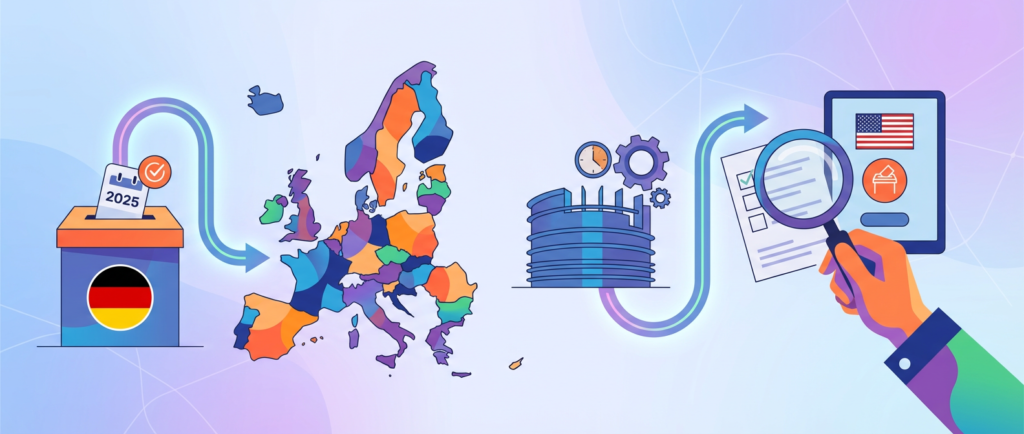
When Coalitions Collapse: Understanding Germany’s Political Earthquake
On February 23, 2025, roughly 61 million Germans walked into polling stations to decide the future of Europe’s largest economy. What they voted on wasn’t just a new government—it was a referendum on whether their political system could recover from three years of governing chaos. The stakes felt enormous, and the turnout numbers proved voters understood it. An 84.4 percent participation rate, the highest in a German federal election since 1987. That’s not a typo. For American observers accustomed to celebrating when our turnout cracks 60 percent, that figure alone should make us stop and ask why.

The immediate context matters. Chancellor Olaf Scholz’s “traffic light” coalition, a three-party alliance between his Social Democrats, the Greens, and the Free Democrats, had limped along for three years before finally collapsing just weeks before the election. Budget disputes, disagreements over economic stimulus, and personality clashes had made the government functionally paralyzed. Scholz dismissed Finance Minister Christian Lindner in a dramatic televised address, and within days the coalition was finished. Germany needed a reset, and voters showed up to deliver one.

The Winners and The Warning Signs
Friedrich Merz’s Christian Democratic Union, along with its Bavarian sister party the Christian Social Union (collectively the CDU/CSU), won decisively with roughly 28.5 percent of the vote. This was the moment the center-right had been waiting for, their chance to lead Europe’s most powerful continental economy. Merz, a lawyer and former parliamentary leader, represented a return to the methodical, technocratic governance that had defined much of Angela Merkel’s era. In another context, his victory would have been straightforward, almost predictable.
Except the second-place finisher sent chills through European capitals. The Alternative for Germany, or AfD, secured approximately 20.8 percent of the vote, its strongest showing in a federal election ever. A far-right party skeptical of NATO, hostile to European integration, and deeply critical of immigration now controlled a fifth of parliament. That’s not theoretical anymore. That’s arithmetic that can’t be ignored. Every major European leader watched those numbers come in, and for many, the question wasn’t who won the election but whether Germany’s democratic guardrails could hold against a political force that challenges some of Europe’s most fundamental commitments.
What made the result even more striking was the generational story embedded within it. Over 1.2 million first-time voters participated in February 2025, the largest cohort of new voters since German reunification. These weren’t bystanders. Younger Germans had been mobilized through TikTok and Instagram campaigns that treated civic participation as something genuinely worth their time. When you see a 19-year-old making a 15-second video explaining voting procedures, or a 22-year-old live-streaming from a polling place, you’re watching democracy rewire itself for a generation that had been written off as checked-out.
The Coalition Negotiations: Democracy Requires Patience
Here’s where Americans watching from abroad should have been taking notes. After the votes were counted, the actual work began. No single party had won enough seats to govern alone. Merz’s CDU/CSU held 28.5 percent. The Social Democrats came in third with around 19.9 percent. The Greens took roughly 12.2 percent. For six weeks, German negotiators hammered out a coalition agreement. Six weeks. Not days. Not a few late nights in a hotel conference room. Six weeks of serious deliberation about immigration policy, economic stimulus, climate goals, defense spending, and the future of welfare provisions.
During those six weeks, something notable happened. NATO allies expressed concern. Publicly. American defense officials worried about clarity on Ukraine aid. The uncertainty of a government still being formed affected real geopolitical calculations. It’s a humbling reminder that democratic institutions, for all their virtues, have real costs when they operate slowly. But the Germans didn’t rush. They built a coalition agreement that could actually function, rather than a hastily assembled majority that would collapse in two years. There are trade-offs in democracy, and Germans seem more comfortable accepting short-term inefficiency for the sake of long-term stability.
What American Voters Can Actually Learn (And What We Can’t Copy)
Let’s be honest about the limits of cross-Atlantic comparison. America’s presidential system, two-party structure, and constitutional design make Germany’s coalition politics impossible to directly replicate here. We don’t have a Bundestag; we have a House and Senate. We don’t negotiate coalitions; we elect one chief executive, full stop. The structural differences run deep and don’t vanish because we admire something about how Germans do politics.
But there’s something about German voter behavior worth studying. That 84.4 percent turnout, especially among first-time voters, reflected a basic recognition that elections have real consequences. The AfD’s second-place finish terrified many Germans not because they were shocked by the result, but because they understood what it meant. A party that questions basic liberal commitments was now a major political force. The response wasn’t apathy. It was mobilization. Millions of Germans, particularly younger ones, decided the future their country took was worth showing up for. They didn’t assume someone else would handle it. They went and voted.
For American voters, that should register. We face our own version of this choice in every cycle, whether democracy is actually something we participate in, or something we watch happen to us. We have different institutions, different histories, different political dynamics. But we face the same basic decision: Do we treat elections as markers of preference, or as moments when we actually take responsibility for our government’s direction?
Europe Waits to See What Berlin Will Do
Germany’s new government eventually took shape, with Merz as Chancellor leading a coalition that had to navigate the complicated question of whether to work with or isolate the far-right AfD. The Official German Federal Election Results showed not just a victory for the center-right, but a serious reshuffling of European political alignments. The European Council on Foreign Relations: Germany Post-Election Analysis offered sobering assessments of how Germany’s internal divisions now translate into European strategic weakness.
Germany’s February election wasn’t exceptional, though. It was a snapshot of what democratic disruption actually looks like when it’s working. Voters held their government accountable for three years of dysfunction. They turned out in massive numbers, including younger voters who had every reason to be cynical. The institutions held. The far-right gained ground but didn’t capture power. Democracy bent but didn’t break.
So what do we do with that observation? American democracy has its own tests: polarization, media fragmentation, declining trust in institutions, a creeping sense that elections don’t really matter. We can’t adopt German voting rules or their coalition system. But we can ask ourselves whether we’re bringing the same energy to our own elections that German voters brought to theirs. Are we treating voting as a real choice about the future, or just another box to check? That’s the real lesson from Berlin.